Self-Determination Theory for music educators: a practical primer.
10 min read.
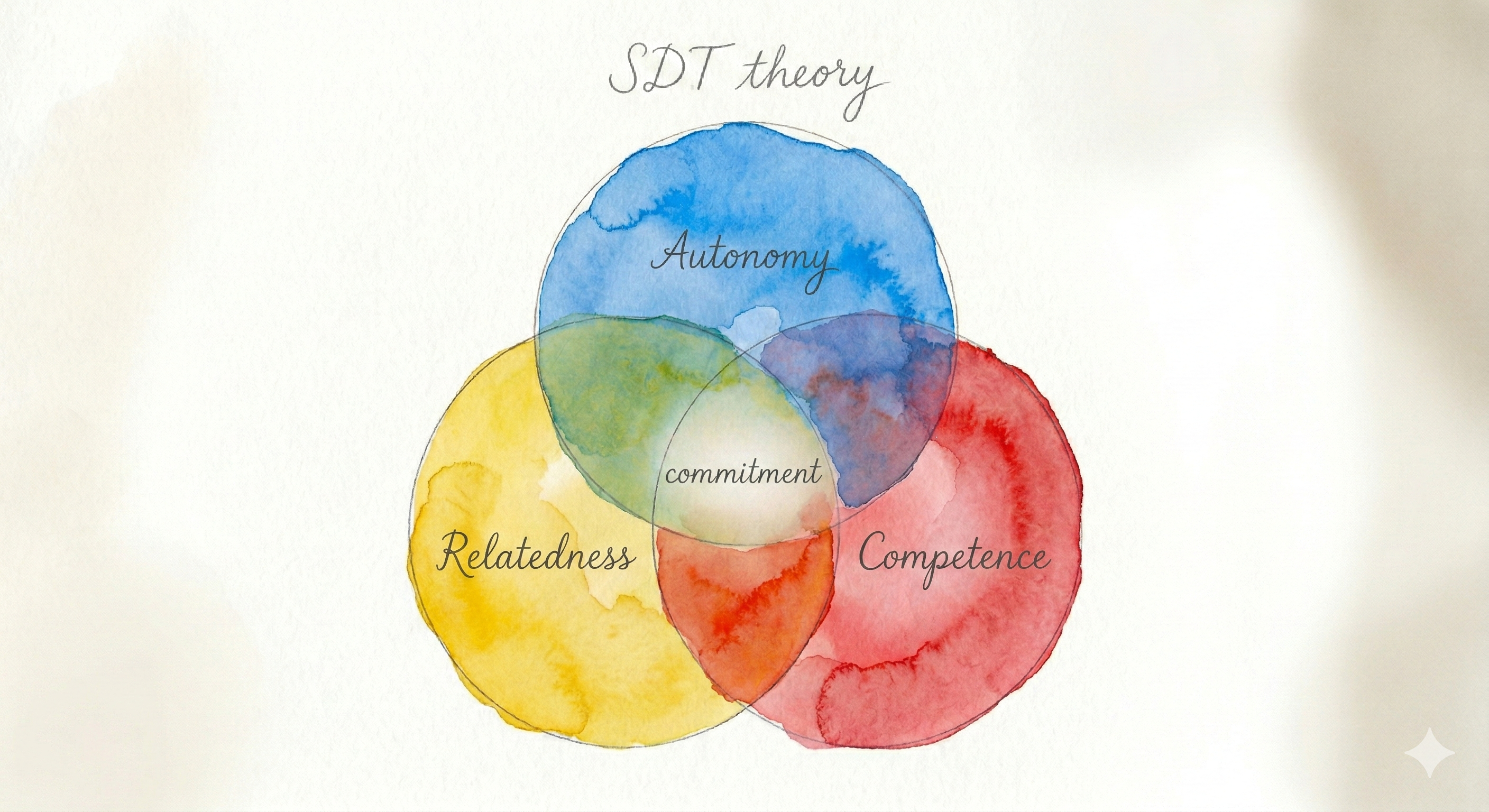
What is Self-Determination Theory?
Self-Determination Theory (SDT) is one of the most extensively researched frameworks in motivational psychology. Developed over four decades by Edward Deci and Richard Ryan at the University of Rochester, SDT has been applied to education, healthcare, sport, workplace motivation, and virtually every domain where human behavior and well-being intersect.
Its central claim is both simple and profound: human beings have three universal psychological needs: competence, autonomy, and relatedness, and when these needs are met, intrinsic motivation and well-being flourish. When they're thwarted, motivation declines and problems follow.
For music educators, SDT is not an abstract academic framework. It describes, with remarkable precision, why some students are intrinsically motivated musicians and why others disengage. It tells us exactly what to do about it.
The three basic psychological needs
1. Competence
The need to feel effective, to experience mastery and see growth. Competence isn't about being the best in the section; it's about feeling that you, personally, are getting better.
In music education, competence is directly undermined when progress is invisible. A student who practices every day but can't perceive improvement has their competence need frustrated, even if they're objectively improving. This is the feedback visibility problem Blini is designed to solve.
Practical implications:
- Give specific, frequent feedback tied to the student's own previous performance
- Design practice tasks at the right challenge level, difficult enough to grow, easy enough to succeed
- Make improvement tangible: recordings, session summaries, progress charts
- Avoid social comparison; focus on personal progress (mastery goals, not performance goals)
2. Autonomy
The need to experience volition, to feel that your actions are self-endorsed, not coerced. Autonomy doesn't mean students do whatever they want. It means they feel a genuine sense of choice and agency within their musical development.
Autonomy is the need most frequently undermined by well-meaning teachers. Nagging students to practice, mandating practice logs, or using grades to enforce compliance are all autonomy-thwarting strategies. The research is clear: they can induce short-term compliance while actively reducing intrinsic motivation.
Practical implications:
- Provide rationale for practice assignments: "here's why this matters to your playing"
- Offer genuine choice where possible: students select some of their practice repertoire
- Use "information-based" rather than "controlling" feedback language
- Let students set (and own) their practice goals with teacher guidance
3. Relatedness
The need to feel connected, to experience genuine care and belonging within a social group. In music education, relatedness is the most underrated motivational force.
Students who feel their teacher knows them personally, who feel that their presence in the ensemble matters, and who feel connected to peers in the program. These students stay. Students who feel invisible leave.
Practical implications:
- Learn and use students' individual goals and interests
- Acknowledge individual contributions to the ensemble's sound
- Celebrate growth publicly but carefully in ways that honor effort, not embarrass struggle
- Make students feel that their practice effort is seen and matters to you
How Blini operationalizes SDT
Every feature in Blini was designed with SDT in mind. Here's the direct mapping:
| SDT Need | Blini Feature | How it helps |
|---|---|---|
| Competence | Post-session insights | Immediate, session-specific feedback makes progress tangible every time |
| Competence | Progress timeline | Long-term growth charts show improvement across weeks and months |
| Competence | Achievement system | Milestone unlocks tied to effort and improvement, not just time logged |
| Autonomy | Screen-free design | No imposed UI during practice: students control their experience |
| Autonomy | Student dashboard | Students own their data and set their own view of progress |
| Relatedness | Teacher visibility | Teachers can see every student's effort and acknowledge it specifically |
| Relatedness | Class-wide celebrations | Shared milestones and ensemble goals build collective identity |
Further reading
- Deci, E. L., & Ryan, R. M. (2000). The "what" and "why" of goal pursuits: Human needs and the self-determination of behavior. Psychological Inquiry, 11(4), 227–268.
- Ryan, R. M., & Deci, E. L. (2017). Self-Determination Theory: Basic Psychological Needs in Motivation, Development, and Wellness. Guilford Press.
- Evans, P. (2015). Self-determination theory: An introduction and review relevant to music education. Bulletin of the Council for Research in Music Education, 203, 7–37.
- Miksza, P. (2015). The development of a measure of self-regulated practice behavior for use with collegiate brass and woodwind players. Journal of Research in Music Education, 63(4), 418–442.
SDT in practice. Try eBlini.
Blini's design is grounded in all three basic psychological needs. See it yourself in the browser.