In a rush?
We've broken down the insights into 8 easy-to-digest Blini-bites at the end of this article. Jump straight to any question.
In a rush?
We've broken down the insights into 8 easy-to-digest Blini-bites at the end of this article. Jump straight to any question.
- 1 Do students like music as a school subject?
- 2 Why do students drop out of school music programs?
- 3 Are music students more motivated in other school subjects too?
- 4 What is the expectancy-value theory of motivation in music education?
- 5 Why is music interest lower in school than outside of school?
- 6 Does competition in school music programs help or hurt student motivation?
- 7 How does autonomy affect student motivation in music?
- 8 What can music teachers do to improve student motivation?
- A study of 3,037 US students found that kids love music outside of school but rank it dead last as a school subject.
- Music learners scored higher on motivation across every dimension measured, including in non-music subjects like English and science.
- The biggest gap: interest in music in school (ranked lowest of all subjects) versus interest in music outside of school (ranked second-highest, and first among high schoolers).
- School music programs lean too heavily on performance and competition, pushing out students who might thrive with more creative, self-directed approaches.
- For teachers looking to close that gap, the answer may involve making practice feel more like the music students already do on their own time, and giving them visible proof that their effort counts.
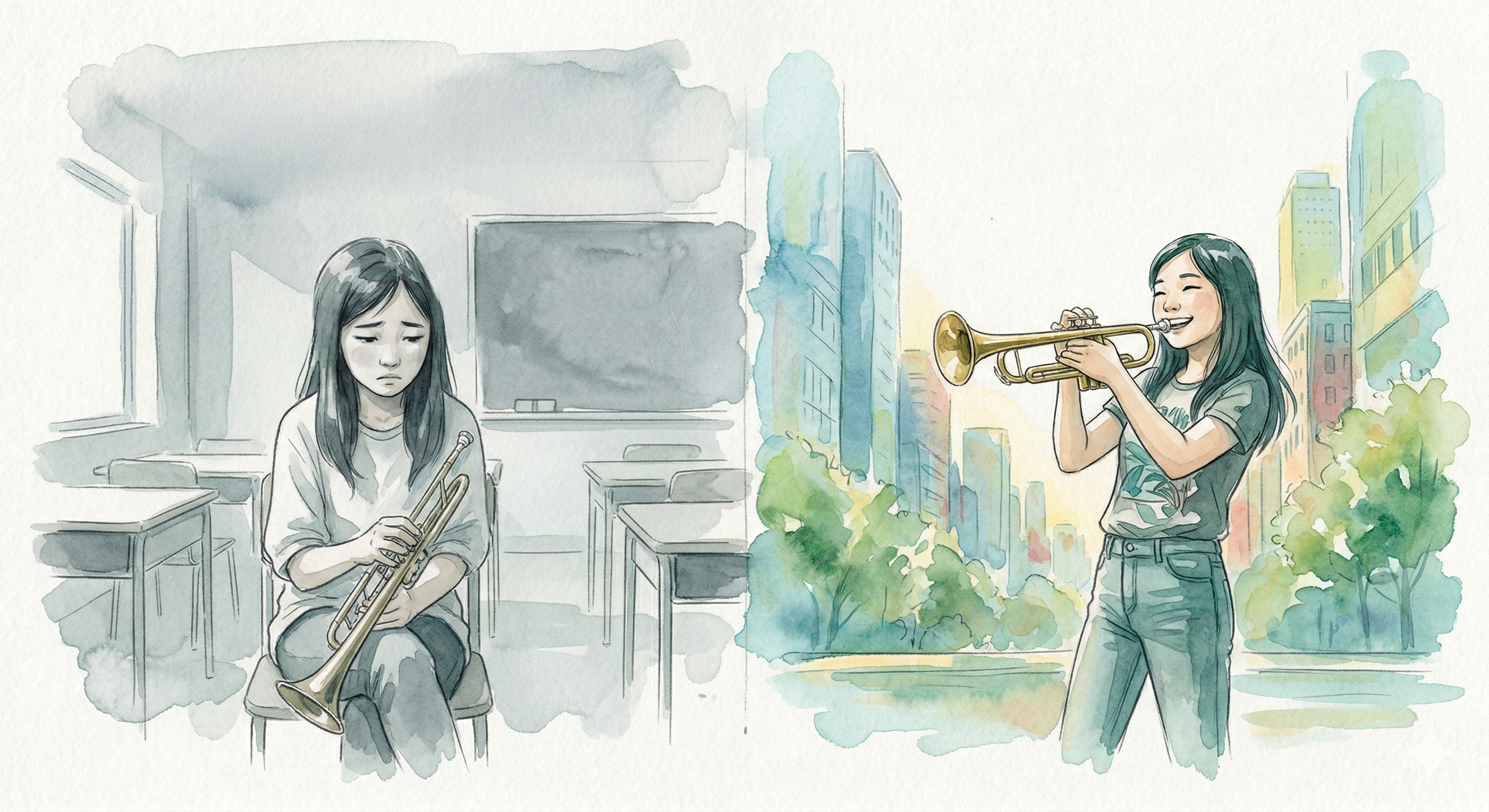
Students love music. They just don't love music class.
A 2010 study by Gary McPherson and Karin Hendricks, published in Research Studies in Music Education, surveyed 3,037 students across US middle schools and high schools. The question was straightforward: how do students feel about music compared to other school subjects?
The answer was uncomfortable. Students ranked music dead last for in-school interest, below math, science, English, art, and PE. The average score was 3.12 on a 5-point scale, lower than every other subject at every grade level measured.
But outside of school? Music jumped to second place in grades 6 and 7-9, trailing only PE. By grades 10-12, music was the top-ranked subject for out-of-school interest, with a mean of 3.79, surpassing even physical education.
That gap tells a story. Students have a problem with how music is experienced in school, not with music itself.
Music interest — in school
3.12 / 5
Ranked last
Below math, science, English, art, PE
Music interest — outside school
3.79 / 5
Ranked #1 in high school
Above all subjects for grades 10–12
Source: McPherson, G. E., & Hendricks, K. S. (2010). Students' motivation to study music: The United States of America. Research Studies in Music Education, 32(2), 201-213.
Key findings from the study
The study used the expectancy-value motivational framework developed by Eccles and colleagues, measuring three dimensions: competence beliefs (how good students think they are), values (how important and useful they consider the subject), and task difficulty.
Competence beliefs
How good students think they are at the subject
Task values
How important and useful they consider the subject
Task difficulty
How hard they believe the subject to be
Eccles et al. (1983) expectancy-value framework applied to 3,037 US students.
Music learners vs. non-music learners. Students who were actively learning an instrument or voice demonstrated higher motivational profiles regarding music than non-music learners on every single measure. Values, competence beliefs, perceived task difficulty, in-school interest, out-of-school interest, and even perceived expectations of parents. All statistically significant at p < .01 with sample sizes above 2,800 per measure.
What's more surprising: music learners also reported higher competence beliefs in art and English, higher values for art, English, and science, and lower task difficulty in art compared to their peers who weren't studying music. Music study appears to carry positive spillover effects into other academic areas.
Music learners outperform non-learners even in other subjects
Art
Competence beliefs ↑
English
Competence beliefs ↑
Art
Values ↑
English
Values ↑
Science
Values ↑
Art
Task difficulty ↓
All differences statistically significant at p < .01, n > 2,800 per measure.
How music compares to other subjects. US students reported lower competence beliefs and values for music and art than for all other subjects tested (math, English, science, PE). Music and art were statistically tied at the bottom on both dimensions.
In-school subject interest — US students (grades 6–12)
Higher bar = higher reported interest. 5-point scale.
Derived from available data, McPherson & Hendricks (2010).
The in-school vs. out-of-school interest gap. This was the most striking finding. In grades 7-9, interest in school music dropped sharply. Then something unusual happened: between grades 7-9 and 10-12, interest in music was the only subject to show a statistically significant increase. No other subject at any grade level showed a rebound like that.
Outside of school, music interest held steady and even climbed. By high school, students ranked music as their most interesting activity outside of school, above PE, art, and all academic subjects.
Out-of-school subject interest
Higher bar = higher reported interest. 5-point scale.
Grades 6–12 overall. Derived from available data, McPherson & Hendricks (2010).
Grade 6 only. Derived from available data, McPherson & Hendricks (2010).
Grades 7–9. Derived from available data, McPherson & Hendricks (2010).
Grades 10–12 : music ranked #1. Derived from available data, McPherson & Hendricks (2010).
What's driving students away from school music?
McPherson and Hendricks point to two structural issues in American music education.
The competition problem
US school music programs have a long tradition built around performance ensembles (band, choir, orchestra) and competitive events like statewide festivals. The researchers cite Radocy (2001), who argued that this competitive emphasis can restrict the repertoire students learn and create opportunities for only an elite minority. It also shifts instruction toward achievement rather than individual growth. When students who aren't already confident in music look at these programs, they see high difficulty with unclear personal payoff. They choose to put their energy into test-driven subjects like math and English instead.
The autonomy problem
Students clearly love music on their own terms. They listen to it, play it informally, and connect it to their social identities during adolescence. But school music programs rarely incorporate students' own musical tastes or give them room for self-directed exploration. The researchers reference findings from Britain showing that much of lower secondary school music is disconnected from students' actual interests (Hargreaves & Marshall, 2003).
The implication is clear: if students experience music at school as something done to them rather than something they choose, motivation drops. And when they can't see how school music connects to the music they care about, it feels irrelevant.
The value perception problem (and why it matters for retention)
The expectancy-value framework used in this study has a specific prediction: students choose to continue with activities they believe are important and useful for their future. The "value" component is the strongest predictor of future choice.
US students in this study valued music less as an academic subject than they valued math, English, science, or PE. Non-music learners in particular reported low values, low competence beliefs, low parent expectations, and high perceived task difficulty for music.
For band and orchestra directors, this creates a retention problem that operates before students even walk through the door. If a 7th grader doesn't see music as valuable compared to other options, and doesn't feel competent enough to succeed, they'll drop the elective. The students who stay tend to be the ones who were already motivated, creating a self-selecting group that can mask the program's broader accessibility issues.
Why low value perception drives dropout
Expectancy-value model (Eccles et al., 1983): perceived value is the strongest predictor of continued enrollment.
The researchers suggest that advocacy efforts focused on showing that music is fun or social aren't enough. Students already know music is enjoyable, as the out-of-school data proves. What they don't believe is that school music is useful and important as an academic pursuit. Advocacy needs to address that perception gap directly, perhaps by showing measurable outcomes and connecting music study to broader educational goals.
What teachers can do: two recommendations from the research
- 1
Broaden the definition of success beyond competition.
When the primary metric of achievement in a music program is a festival rating or an all-state selection, most students will never feel successful. Programs that include composition and improvisation, or space for personal creative expression, give more students a reason to invest. The researchers note that students who perceive music as having high task difficulty and being reserved for a "talented" minority are the ones who leave.
- 2
Create space for student-directed musical activity.
The data on out-of-school interest suggests that students want to engage with music that connects to their own lives and identities. Programs that build in some autonomy, where students choose repertoire or set their own practice goals, could close the gap between in-school and out-of-school motivation.
Both recommendations align with decades of research on self-determination theory: people persist at activities where they feel competent and autonomous, and where they belong.
What this means for tracking student progress
One pattern in the data deserves attention from a practical standpoint. Non-music learners reported higher task difficulty and lower competence beliefs. They didn't feel good enough at music, and they thought it was hard. Music learners felt the opposite.
That perception gap doesn't have to be permanent. When students can see concrete evidence that their effort is producing results, competence beliefs shift. A student who practices for two weeks and sees nothing different has no reason to believe they're improving. A student who gets clear, specific feedback on their consistency and progress has a factual basis for feeling competent.
Visible progress builds competence beliefs
The challenge is that most music teachers manage 50 to 100 or more students and have limited class time. Collecting and communicating progress data at an individual level is extremely time-consuming with traditional tools. Practice logs and self-reporting are both notoriously unreliable, and asking students to open yet another app or screen during practice adds friction that can actually reduce practice behavior.
The most promising approach is one that captures progress data passively, without requiring the student to interact with a screen during practice, and then surfaces that data to the teacher in a format they can act on. A physical device on a music stand, for instance, can track whether practice is happening without pulling a student into a digital environment. The teacher then sees who is showing up consistently, who is struggling, and where encouragement or intervention is needed.
When students can see their own consistency over time, and when teachers can point to real data showing growth, the "usefulness" and "importance" of music study become visible in a way that words alone can't achieve.
Making practice visible without adding screens
The McPherson and Hendricks study was published in 2010, but the problems it identified have only intensified. Screen fatigue in schools has increased. Students are spending more time on devices for other classes, and adding another app to track music practice competes for attention and contributes to digital overload.
The phygital approach, where a physical device handles the sensing and habit reinforcement while digital tools handle the data aggregation for teachers, addresses both the autonomy and the feedback loops this research calls for. Students practice their instrument. A small device on their stand registers that practice happened. No screen needed during the session. Teachers see the resulting data in a classroom dashboard: who practiced, how consistently, and where the trends are heading.
That kind of passive tracking preserves the autonomy students want (they choose when and how to practice) while generating the progress data teachers need to demonstrate value to students, parents, and administrators.
Traditional approach
- ✕ Paper practice logs (unreliable)
- ✕ App-based tracking (screen friction)
- ✕ Self-reporting (easy to fill out in the car)
- ✕ Teacher guesswork on who practiced
Phygital approach
- ✓ Physical device on the music stand
- ✓ Passive detection : no screen during practice
- ✓ Preserves student autonomy over what they practice
- ✓ Teacher dashboard with real, reliable data
The bottom line for music educators
This study makes the case that the motivation problem in school music is a perception problem. Students love music. They don't see school music as worth their time compared to other subjects. Changing that requires broadening what counts as success in a music program and making the value of consistent practice visible.
If you're a band or orchestra director working to retain students and justify your program, the data here suggests that competition results alone won't persuade students who are on the fence. Showing them clear, personal evidence that they're improving, and giving them some ownership over their musical journey, will.
Source: McPherson, G. E., & Hendricks, K. S. (2010). Students' motivation to study music: The United States of America. Research Studies in Music Education, 32(2), 201–213.