In a rush?
We've broken down the insights into easy-to-digest Blini-bites at the end of this article. Jump straight to any question.
In a rush?
We've broken down the insights into easy-to-digest Blini-bites at the end of this article. Jump straight to any question.
- 1 What is self-determination theory and why does it matter for music teachers?
- 2 Do rewards and incentives help students practice more?
- 3 What does "autonomy" mean in music education, and how is it different from just letting students do whatever they want?
- 4 How does student choice of repertoire affect practice behavior?
- 5 Why do some students feel like they "don't have what it takes" to play an instrument, and what can teachers do about it?
- 6 How does the parent-student relationship affect whether a child stays in a music program?
- 7 What's the difference between a student who practices because they "should" and one who practices because they love music?
- 8 Can high-stakes music examinations hurt student motivation?
- 9 Is it possible to support autonomy in a structured ensemble setting?
- 10 What happens to a student's motivation over time if their psychological needs keep being thwarted?
- 11 Do all three psychological needs need to be met, or is one more important than the others?
- 12 What's the earliest visible sign that a student is losing motivation for music?
- Students whose psychological needs for competence, relatedness, and autonomy are met in music programs are more likely to keep playing and to develop genuine, lasting motivation, according to Evans (2015).
- External rewards such as gold stars, monetary incentives, and high-stakes examinations can undermine intrinsic motivation over time, even when they appear to work in the short term.
- In a study of 157 children, not one student whose parents used rewards as practice incentives continued music beyond one year or reported playing as an adult.
- The quality of motivation matters more than the quantity: a student who practices because they value music will practice more effectively than one who practices to avoid parental pressure.
- Music teaching frequently thwarts student autonomy without meaning to, through prescriptive lesson structures, director-chosen repertoire, and perfectionistic standards, and Evans identifies concrete ways to change this.
- Balanced need fulfillment across all three needs produces better wellbeing outcomes than having one need strongly met while others are neglected.
Every year, band and orchestra directors watch kids they've taught for months walk out the door and not come back. The reasons are usually fuzzy: "It got too hard." "My friends weren't doing it." "I just lost interest." These explanations feel unsatisfying because they're symptoms, not causes. What's actually happening beneath them?
Paul Evans, writing in Musicae Scientiae in 2015, spent nineteen pages working through that question using self-determination theory (SDT) as the lens. The paper is a conceptual review, not an empirical study, so Evans isn't reporting new data from his own experiment. Instead, he synthesizes two decades of motivation research from psychology, education, and music specifically, and makes the case that SDT is the best available framework for understanding why students stay in music or leave it. It's a dense paper, but the implications for anyone running a K–12 program are direct and sometimes uncomfortable.
The central argument is this: motivation research in music has been fragmented, pulling from expectancy-value theory, self-efficacy, attribution theory, and identity development without connecting them into a coherent picture. SDT, Evans argues, can serve as that connecting framework because it addresses not just how much motivation a student has, but what kind of motivation they have, and where it comes from.
Why music motivation research needed a unified theory
Music education researchers have produced a substantial body of work on why students practice, persist, or quit. The problem is that these studies tend to stay in their own theoretical lanes. A self-efficacy study and an expectancy-value study might both look at the same population of sixth-grade band students and find overlapping results, without the researchers noticing that they're measuring different facets of the same underlying phenomenon.
Evans argues that this theoretical fragmentation isn't just an academic annoyance. It makes it harder for practitioners to draw reliable conclusions, and it makes it harder to design interventions. If every study uses a different vocabulary for motivation, you can't stack findings on top of each other.
SDT, originally developed by Edward Deci and Richard Ryan across decades of work, offers a metatheory: a broad framework that contains several smaller theories, each addressing a different aspect of human motivation. Evans proposes that many of the constructs music researchers have already been studying, including self-efficacy, mastery orientation, and parental involvement, can be reinterpreted as components of the SDT framework, which means existing research isn't wasted. It just needs to be reread through a more unified lens.
The three psychological needs and what they look like in a band room
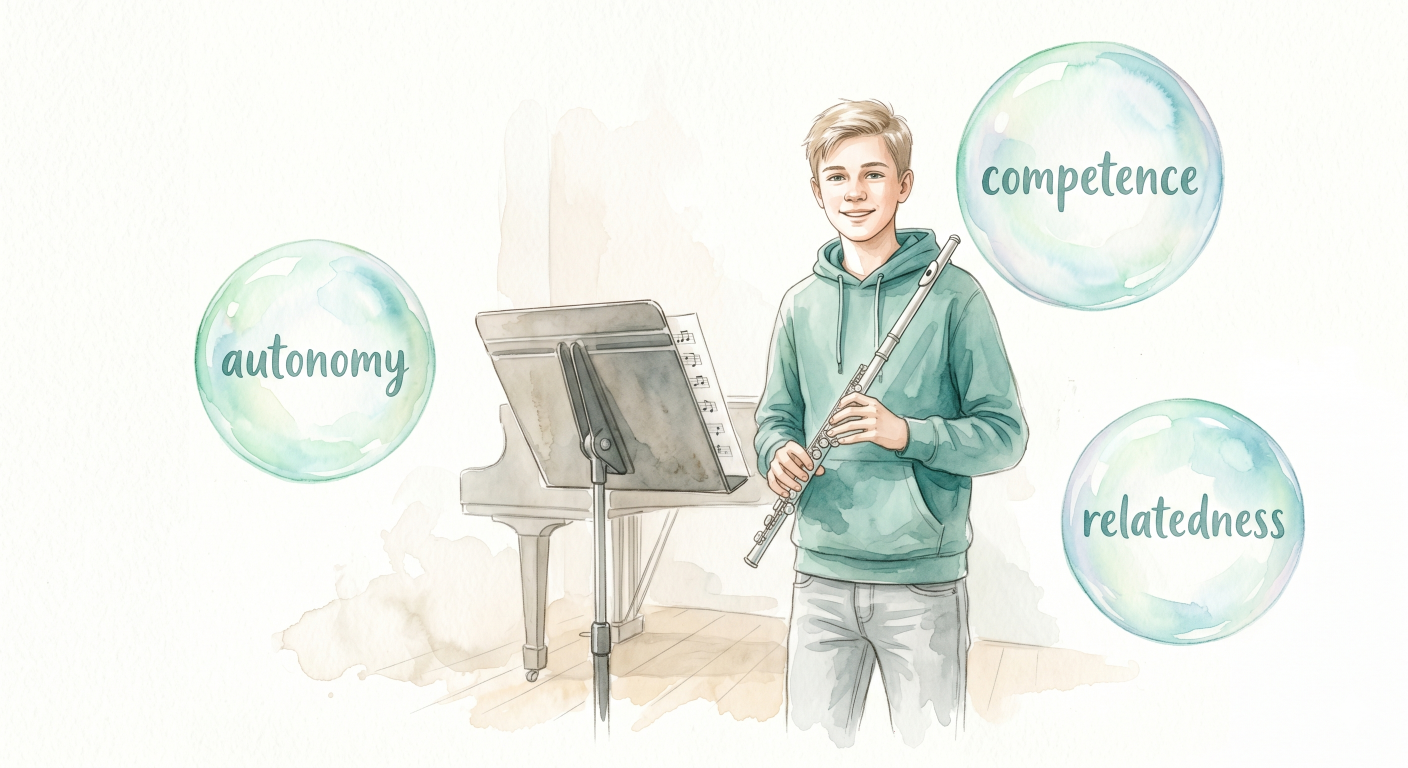
SDT starts from the premise that humans have three basic psychological needs that are innate and universal: competence, relatedness, and autonomy. These aren't preferences or personality traits. Evans describes them as nutriments, things that psychological health depends on in the same way that physical health depends on food and water. When they're met, students grow. When they're thwarted, students suffer, and often quit.
Each of these needs has a specific meaning in SDT that's slightly different from how we use the words colloquially. Getting each definition right matters, because the teaching implications flow directly from the definitions.
Competence
The felt sense of being able to make progress, to effect change, to see effort translate into improvement.
Relatedness
The baseline felt sense of belonging and connection that makes other kinds of engagement possible.
Autonomy
The sense that behavior is volitional, self-initiated, and congruent with one's sense of self.
Competence: why beliefs about ability matter more than actual ability
The need for competence, as Evans explains, is the desire to feel effective in one's skills and interactions. It isn't the same as being competent. It's the felt sense of being able to make progress, to effect change, to see effort translate into improvement.
In music, this maps onto a body of research about fixed versus growth mindsets. Students who believe musical ability is innate and fixed, that some people "have it" and others don't, tend to avoid challenges and give up when things get hard. Students who believe ability can be developed through effort are more likely to persist, attribute setbacks to effort rather than talent, and seek out difficult material. Evans cites O'Neill and Sloboda's finding that children with a fixed orientation did twice as much practice as those with a growth orientation to reach the same performance level. More practice, less effective, worse outcomes. That's not a practice quantity problem. That's a belief problem.
For teachers, this has a specific implication that Evans makes explicit in Table 1 of the paper: praising effort and strategy rather than ability or outcome is needs-supporting. Comparing students to each other, emphasizing competition, and maintaining perfectionistic standards in lessons are needs-thwarting. The difference between "you played that passage really cleanly today" and "you must have a natural ear" is, according to SDT, the difference between feeding the competence need and quietly undermining it.
Needs-thwarting
- "You must have a natural ear."
- Comparing students to one another
- Emphasizing competition and chair rankings
- Maintaining perfectionistic standards
Needs-supporting
- "You played that passage cleanly today."
- Praising effort and strategy over outcome
- Encouraging a growth mindset
- Teaching practice strategies explicitly
Evans also draws attention to what happens when students feel genuinely incompetent, when the music is too hard, the feedback is relentlessly negative, or the gap between their ability and their peers' seems impossible to close. In a voluntary activity like music, the response to thwarted competence is almost always exit. Students don't double down when they feel ineffective. They leave.
Autonomy: the most misunderstood need in music education
Autonomy in everyday language suggests freedom or independence. In SDT, Evans explains, the definition is more precise: autonomous behavior is behavior that feels volitional, self-initiated, and congruent with the sense of self. It's the opposite of feeling controlled, coerced, or pressured from outside.
Critically, autonomy is not the same as laissez-faire teaching. Evans is explicit about this. Research shows that structure is compatible with, and even supportive of, autonomy. Students can feel autonomous within a structured, teacher-directed classroom if they endorse the value of what they're doing and trust the teacher's guidance. What thwarts autonomy is control: being told what to do without explanation, being excluded from decisions about repertoire or learning activities, being pressured to perform well for ego-based reasons.
Classical music education, Evans argues, has a structural autonomy problem. Studio teaching tends to be prescriptive. The teacher selects the repertoire, designs the lesson plan, assigns the practice tasks, and evaluates the outcome. A study cited by Evans found that teacher talk dominated the available time in studio lessons far more than student activity. Ensemble directors almost always choose the repertoire. Students have very little input into the direction of their own musical development.
Evans is careful to say that this often isn't the teacher's intention. It's the style of teaching that tends to emerge from the tradition.
The Clarissa case study
A twelve-year-old clarinet student was working on a required piece. Her teacher mentioned a different arrangement in passing, and Clarissa asked if she could learn it. In her subsequent practice sessions, she spent more than twelve times longer per note on the piece she had chosen. Her practice was also qualitatively different: more strategic, more focused, using techniques she hadn't applied to the assigned material. The only thing that changed was that she had chosen the piece.
Twelve times longer per note. For a teacher managing 80 students who all claim they're practicing, that number is striking. Autonomy support isn't just psychologically nice. It produces different practice behavior.
Intrinsic vs. extrinsic motivation: what the research actually shows
Evans devotes a substantial section to the distinction between intrinsic motivation (doing something because it's inherently interesting or enjoyable) and extrinsic motivation (doing something for reasons outside the task itself). This is where SDT gets uncomfortable for some teachers.
The core finding, replicated across decades of research and summarized by Evans, is that extrinsic motivators don't add to intrinsic motivation. They interact with it in a way that tends to reduce it. Deci's original 1971 experiment is illustrative: participants who received monetary rewards for solving puzzles spent less free time solving puzzles afterward than those who received no reward. The reward hadn't motivated them more. It had shifted their attention away from the inherent interest of the task and toward the external payoff.
In music, external motivators are everywhere. Gold stars, stickers, praise for compliance, monetary allowances tied to practice time, high-stakes examinations, competition placements. Teachers and parents reach for these because they appear to work in the immediate moment. And Evans acknowledges that they do appear to work, short term. The student complies. The practice log gets signed.
The number that's hard to set aside
Among 157 children in the Faulkner, Davidson, and McPherson (2010) study cited by Evans, not one student whose parents used rewards as practice incentives continued music beyond one year or reported playing or learning music as an adult. Not one. The rewards generated compliance. They did not generate musicians.
This doesn't mean that all external motivation is equally damaging. Evans is careful about this distinction.
The motivation spectrum: from "I don't want to practice" to "I lose track of time"
SDT doesn't treat extrinsic motivation as a single thing. Evans describes a continuum with four types of extrinsic motivation that range from fully external to nearly internal, alongside amotivation on one end and intrinsic motivation on the other.
External regulation
"I practice because my teacher said to" or "I'll get in trouble if I don't." When the external pressure disappears, the behavior disappears with it.
Introjected regulation
"I practice because I'll feel guilty if I don't." The external regulator has been internalized as self-administered pressure, often producing anxiety and shame.
Identified regulation
"I don't love practicing scales, but I understand why they're important and I value what they do for my playing." The student endorses the activity.
Integrated regulation
"Music is central to who I am, and practicing is part of how I build that identity." The behavior is fully aligned with the student's sense of self.
The practical point is that identified and integrated regulation are where teachers should be aiming. These forms of motivation are self-sustaining in a way that external regulation never will be. And they can be developed, which is the point of Evans's integrated model.
A telling example from the paper: Koestner, Ryan, Bernieri, and Holt (1984), cited by Evans, asked children to keep their painting materials clean. One group received a simple explanation of why cleanliness mattered for the quality of their painting. The other was given the rule without explanation. The first group produced more creative paintings. The explanation, not the rule, was what made the difference. For teachers assigning practice tasks: explaining why a scale exercise matters for technique, what it's training and why that will help, is not just better pedagogy. It's a different form of motivation regulation.
An integrated model: how needs fulfillment and internalization connect
The two parts of SDT that Evans covers, basic psychological needs and the internalization continuum, are not separate frameworks. They're linked. Motivation is internalized to the degree that psychological needs are met. When a student feels competent, connected, and autonomous in their music learning, they are more able to take on the values of their teachers and their musical community and make those values their own. The practice becomes genuinely theirs, not a performance of compliance.
Evans adapts a hierarchical model from Vallerand (1997) to show how motivation operates at three levels simultaneously. At the global level, a student has a general motivational orientation toward life. At the contextual level, they have a specific orientation toward music. At the situational level, they experience individual lessons, practice sessions, or ensemble rehearsals as more or less internally motivated.
Vallerand's hierarchical model: three levels of motivation
Global
A student's general motivational orientation toward life. Relatively stable across contexts.
Contextual
Their specific orientation toward music. Shaped by accumulated experiences in the program.
Situational
How they experience individual lessons, practice sessions, or rehearsals right now.
What matters for teachers is the bidirectional flow between levels. A single bad lesson, in which a student feels humiliated or controlled, will not usually destroy their contextual motivation for music. But a pattern of such lessons will. Accumulated negative situational experiences gradually shift the contextual level toward external regulation, and eventually toward amotivation. The student starts dreading lessons. Then they start finding reasons to skip. Then they're gone.
The inverse also operates. Creating positive situational experiences, moments of genuine competence, belonging, and choice, gradually builds upward into a more internalized contextual motivation. Students who have had enough of those experiences start to carry them even through difficult patches.
What teachers can do with this today
Evans's Table 1 is worth printing out and keeping somewhere visible. It maps needs-supporting and needs-thwarting behaviors across all three psychological needs, in the context of music teaching specifically.
For competence
Supporting: Encourage a growth mindset, de-emphasize talent narratives, praise effort and strategy over outcomes, teach practice strategies explicitly.
Thwarting: Avoid comparing students to peers, avoid framing examinations or competitions as the main measure of musical success.
For relatedness
Supporting: Build a warm, bidirectional relationship with students, facilitate connections between students within the program, acknowledge that friendships sometimes compete with practice.
Thwarting: Avoid manipulating students through guilt or shame. Be aware of how music participation affects a student's social standing outside the classroom.
For autonomy
Supporting: Provide rationales when giving instructions, offer choices within structure (repertoire, practice goals, learning activities), acknowledge students' feelings including anxiety and frustration.
Thwarting: Avoid following the same prescriptive lesson plan every week, avoid instructions delivered without explanation, avoid assigning arbitrary time minimums.
Evans also makes a point that's easy to miss: balanced needs fulfillment matters. In research by Sheldon and Niemiec (2006), cited in the paper, students whose needs were met in balance across all three areas had better wellbeing outcomes than students who had one need very strongly met while others were neglected. A student who practices obsessively at the expense of friendships may be getting competence but losing relatedness. The imbalance itself is a risk factor.
Finally, Evans acknowledges the complexity of examinations. SDT would predict that high-stakes evaluations undermine intrinsic motivation by introducing external regulation. But Renwick's 2008 study of 677 students preparing for AMEB examinations found that many students still showed motivation closer in quality to intrinsic than expected, with intrinsic motivation remaining a stronger predictor of effective practice than extrinsic motivation. Evans's interpretation is that students who experience examinations as opportunities to demonstrate mastery and celebrate progress, rather than as external judgment, may not experience them as controlling. Context and framing, as usual, shape the effect.
Source: Evans, P. (2015). Self-determination theory: An approach to motivation in music education. Musicae Scientiae, 19(1), 65–83. doi:10.1177/1029864914568044